Delving into the world of home brewing unlocks a realm of flavor, mirroring the expertise found in professional settings. Like Starbucks’ detailed training, mastering techniques elevates your daily ritual.
The Rise of Home Baristas
A fascinating shift has occurred in coffee culture: the democratization of specialty coffee preparation. Once confined to cafes and skilled professionals, the art of crafting exceptional coffee is now flourishing within homes globally. This surge is fueled by increased access to information – resources mirroring the comprehensive training found in documents like the Starbucks barista training manual PDF – and a growing desire for personalized experiences.
Individuals are no longer content with simply consuming coffee; they aspire to understand the nuances of bean origin, grind size, brewing methods, and flavor profiles. The availability of detailed guides, online communities, and quality equipment empowers enthusiasts to replicate café-quality beverages. This trend signifies a move towards mindful consumption and a deeper appreciation for the coffee-making process, transforming consumers into passionate home baristas.
Why Brew at Home?
The allure of home coffee brewing extends far beyond mere convenience; it’s about control, cost-effectiveness, and customization. While resources like the Starbucks barista training manual PDF detail professional standards, home brewing allows for personal experimentation and tailoring to individual preferences. You dictate the bean origin, roast level, and brewing parameters, achieving a cup perfectly suited to your palate.
Economically, brewing at home significantly reduces expenses compared to daily café visits. Furthermore, it fosters a mindful ritual, offering a moment of calm and creativity. Mastering techniques, even those outlined in professional guides, provides a sense of accomplishment and a deeper connection to the coffee itself. Ultimately, home brewing empowers you to become the architect of your own coffee experience.

Essential Equipment
Just as Starbucks training manuals emphasize quality tools, home brewing requires key investments: a grinder, scale, kettle, and chosen brewing device for optimal results.
Coffee Grinders: Burr vs. Blade
The foundation of exceptional coffee lies in a consistent grind, a principle heavily stressed within Starbucks barista training. Two primary grinder types exist: burr and blade. Blade grinders, resembling spice grinders, chop beans unevenly, creating inconsistent particle sizes and impacting flavor extraction – often resulting in bitterness.
Burr grinders, however, utilize two revolving abrasive surfaces (burrs) to crush beans to a uniform size. This consistency is crucial for even extraction, unlocking the coffee’s full potential. Starbucks exclusively employs burr grinders for this reason.
Conical burrs are quieter and produce less heat, while flat burrs offer greater consistency. Investing in a quality burr grinder, though initially more expensive, dramatically improves coffee quality and mirrors the professional standards detailed in Starbucks’ comprehensive training materials.
Water Filtration: Importance and Options
Starbucks’ barista training emphasizes water quality as paramount to exceptional coffee; approximately 98% of coffee is water! Impurities in tap water – chlorine, minerals, and other contaminants – significantly detract from coffee’s nuanced flavors. Filtration removes these, allowing the coffee’s true character to shine.
Several filtration options exist. Pitcher filters, like Brita, are affordable but offer limited capacity. Faucet filters provide on-demand filtration. Under-sink filters deliver higher capacity and better filtration, closely mirroring Starbucks’ standards. Whole-house filtration systems offer comprehensive water purification.
The ideal water for coffee brewing should be clean, odorless, and free of chlorine. Starbucks utilizes sophisticated multi-stage filtration systems, and replicating this at home, even partially, yields noticeably improved results, as highlighted in their training.

Brewing Vessels: Choosing the Right One
Similar to Starbucks baristas selecting equipment for specific beverages, your brewing vessel profoundly impacts the final cup. The Starbucks training manual details precise equipment usage; at home, choices abound. French presses excel at full immersion, yielding a rich, heavy-bodied brew.
Pour-over devices, like Hario V60 or Chemex, prioritize control and clarity, demanding a slower, more deliberate process. Automatic drip machines offer convenience, though quality varies greatly. Aeropresses provide versatility, suitable for various brew styles.
Consider your preferences: do you value convenience, control, or a specific flavor profile? Material matters too – glass, stainless steel, and ceramic each influence heat retention and flavor neutrality. Selecting the right vessel is crucial, mirroring Starbucks’ focus on optimized tools.
Popular Brewing Methods
Exploring diverse techniques, much like Starbucks barista training, reveals a spectrum of flavors and experiences. Each method offers unique control and results.
Drip Coffee Makers: Convenience and Consistency
Drip coffee makers represent the cornerstone of convenient home brewing, offering a reliable and consistent cup with minimal effort. Much like the standardized procedures emphasized within a Starbucks barista training manual, these machines prioritize repeatable results. They automate the brewing process, controlling water temperature and saturation time, though often with less user control than other methods.
Modern drip machines frequently include programmable timers, allowing for wake-up-and-brew functionality. While not offering the nuanced control of pour-over or French press, quality drip makers can produce excellent coffee, especially when paired with freshly ground beans. Understanding grind size and water quality, principles detailed in professional training, significantly impacts the final brew. They are ideal for larger batches and everyday use, embodying simplicity and efficiency.
French Press: Full-Bodied Flavor
The French press, a celebrated brewing method, delivers a rich, full-bodied coffee experience through full immersion. Unlike the precise timing of espresso machines detailed in a Starbucks barista training manual, the French press relies on a longer steeping period. This allows for greater extraction of oils and sediment, contributing to its characteristic texture and robust flavor profile.
Coarse ground coffee is essential to prevent clogging the filter. The process involves combining coffee grounds with hot water, steeping for approximately four minutes, and then slowly pressing the plunger to separate the grounds. Mastering the grind size and water temperature, concepts mirrored in professional training, is crucial. While requiring a bit more hands-on attention, the French press offers a rewarding and flavorful cup, showcasing coffee’s inherent complexities.
Pour Over: Control and Precision
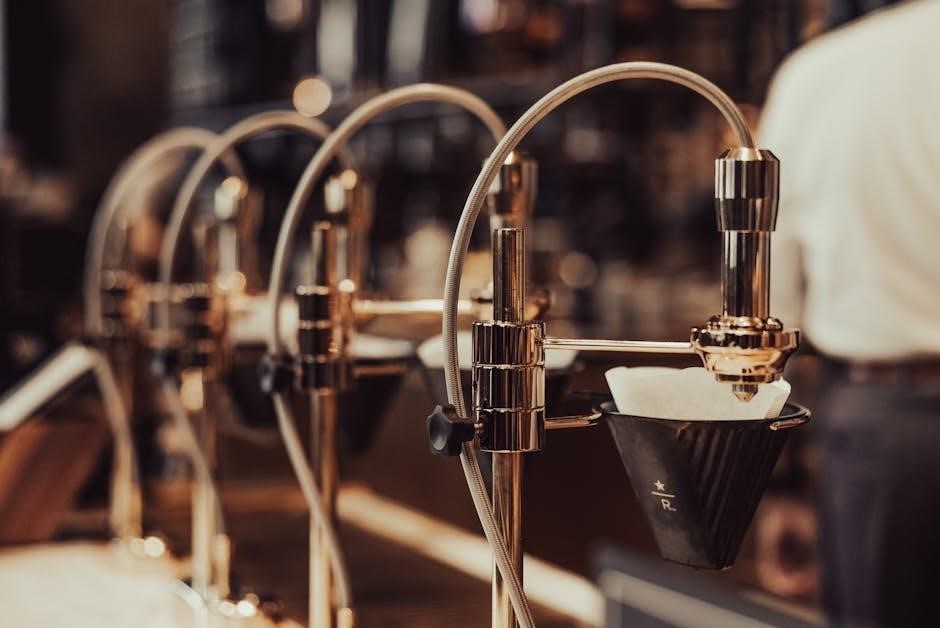
Pour over brewing epitomizes control and precision, allowing for a highly customized coffee experience. Similar to the meticulous standards emphasized in a Starbucks barista training manual, pour over demands attention to detail. This method involves slowly pouring hot water over coffee grounds held in a filter cone, controlling bloom, flow rate, and saturation.
The resulting coffee is clean, bright, and nuanced, showcasing the bean’s unique characteristics; Grind size is critical – medium-fine is generally recommended. Mastering the circular pouring technique ensures even extraction. While seemingly simple, achieving consistency requires practice and understanding of brewing variables. Like a skilled barista, you dictate the final flavor profile, making pour over a truly rewarding method for coffee enthusiasts seeking ultimate control.
Aeropress: Versatility and Portability
The Aeropress stands out for its remarkable versatility and portability, offering a unique brewing experience. Though not directly covered in a standard Starbucks barista training manual, its adaptability mirrors the problem-solving skills baristas develop. This immersion-style brewer utilizes air pressure to force coffee through a filter, resulting in a smooth, concentrated brew.
Its compact design makes it ideal for travel or small spaces. Experimentation is key – varying grind size, water temperature, and steep time unlocks a wide range of flavor profiles; The Aeropress is forgiving, allowing for adjustments to suit individual preferences. It’s a fantastic option for those seeking a quick, clean, and customizable cup, embodying a spirit of innovation akin to modern coffee practices.
Advanced Techniques
Refining brewing involves precise control, mirroring Starbucks’ emphasis on consistency. Mastering water temperature, ratios, and bloom phases unlocks nuanced flavors and optimal extraction.
Water Temperature: The Goldilocks Zone
Achieving the ideal water temperature is paramount for optimal coffee extraction, a principle deeply ingrained in Starbucks barista training. Water that’s too cold will result in under-extraction, yielding a sour and weak brew, lacking the full potential of the coffee grounds. Conversely, excessively hot water can lead to over-extraction, producing a bitter and harsh taste.
The “Goldilocks Zone” generally falls between 195-205°F (90-96°C). Starbucks emphasizes precise temperature control for each brewing method. For example, pour-over methods benefit from a slightly higher temperature within this range, while drip coffee makers often operate optimally at the lower end. Utilizing a thermometer is crucial for consistency. Remember, even slight variations can significantly impact the final cup’s flavor profile, mirroring the standards upheld in professional barista environments.
Coffee-to-Water Ratio: Finding Your Sweet Spot
The coffee-to-water ratio is a foundational element of brewing, meticulously detailed within Starbucks’ barista training materials. This ratio dictates the strength and balance of your coffee. A general guideline is a 1:15 to 1:18 ratio – meaning 1 gram of coffee for every 15-18 grams of water; However, personal preference plays a significant role.
Starbucks baristas learn to adjust this ratio based on bean type, roast level, and desired brew strength. A lower ratio (e.g., 1:15) yields a stronger, more concentrated brew, while a higher ratio (e.g., 1:18) produces a lighter, more nuanced cup. Precise measurement, using a scale, is essential for repeatability. Experimentation is key to discovering your “sweet spot,” mirroring the customized approach Starbucks employs to cater to diverse palates.
Bloom Phase: Maximizing Flavor Extraction
The “bloom” is a crucial initial step in pour-over and French press brewing, heavily emphasized in Starbucks barista training. It involves saturating freshly ground coffee with a small amount of hot water – roughly twice the weight of the coffee – and allowing it to rest for 30-45 seconds. This process releases trapped carbon dioxide, a byproduct of roasting.
Starbucks baristas are taught that the bloom allows for optimal flavor extraction by preparing the coffee grounds for even saturation. Visually, you’ll observe bubbling and expansion as the gases escape. Skipping the bloom results in uneven extraction and a potentially flat, underdeveloped flavor. Proper blooming ensures a richer, more aromatic, and balanced cup, demonstrating the importance of understanding coffee chemistry – a core tenet of Starbucks’ brewing philosophy.

Troubleshooting Common Issues
Like Starbucks’ detailed guides for consistency, identifying and correcting brewing flaws is key. Addressing bitterness, weakness, or unevenness ensures a perfect cup every time.
Bitter Coffee: Causes and Solutions
Bitterness in coffee often signals an imbalance during extraction, mirroring issues addressed in Starbucks barista training. Over-extraction, where too much is pulled from the grounds, is a primary culprit. This happens with excessively fine grinds, water that’s too hot, or prolonged brewing times.
Conversely, under-developed coffee – beans not roasted sufficiently – can also contribute to a harsh taste. Solutions include adjusting your grind size to be coarser, lowering water temperature slightly (aim for 195-205°F), and shortening brew duration.
Ensure your equipment is clean; residual oils can impart bitterness. Finally, consider the bean itself – darker roasts naturally exhibit more bitterness, so experiment with lighter options if preferred. Consistent adjustments, much like a Starbucks barista’s approach, will yield optimal results.
Weak Coffee: Adjusting Your Brew
A weak or underwhelming cup of coffee typically indicates under-extraction, a common issue Starbucks training emphasizes avoiding. This means insufficient solubles were extracted from the coffee grounds. The most frequent cause is using too little coffee for the amount of water – a simple fix is increasing your coffee-to-water ratio.
Another factor is a grind that’s too coarse; finer grinds increase surface area for extraction. Ensure your water isn’t too cool, as lower temperatures hinder the process.
Also, check your brewing time; it might be too short. Like a skilled Starbucks barista, systematically adjusting these variables – ratio, grind size, temperature, and time – will lead to a bolder, more satisfying brew. Experimentation is key!
Uneven Extraction: Achieving Consistency
Uneven extraction results in a muddled, unbalanced flavor profile – something Starbucks baristas are rigorously trained to prevent. This occurs when water doesn’t contact all coffee grounds equally, leading to some being under-extracted (sour) and others over-extracted (bitter). A consistent grind size is paramount; inconsistent particles extract at different rates.
Proper saturation is crucial. In pour-over methods, ensure all grounds are evenly wet during the bloom phase. For drip machines, a quality filter and even water distribution are vital.
Stirring during brewing (like in a French press) promotes even saturation. Starbucks’ emphasis on technique highlights that consistency in every step yields a predictably delicious cup.

Exploring Different Coffee Beans
Just as Starbucks training details bean origins, understanding Arabica versus Robusta, single-origin versus blends, and roast levels unlocks a world of nuanced flavors.
Arabica vs. Robusta: Understanding the Differences
Arabica beans, favored for their smoother, more aromatic profile, represent the majority of global coffee production. Starbucks training emphasizes recognizing these nuanced flavors – often described as having notes of chocolate, caramel, or fruit. Grown at higher altitudes, Arabica requires specific climate conditions, contributing to its generally higher cost.
Robusta, conversely, boasts a bolder, more bitter taste with a higher caffeine content. It’s often used in espresso blends to create a thicker crema. Like the detailed information in a Starbucks barista manual, understanding Robusta’s resilience – thriving in warmer climates and resisting disease – explains its lower price point.
Ultimately, the choice between Arabica and Robusta depends on your preferred taste and brewing method. Experimentation, guided by knowledge, is key to discovering your ideal cup.
Single Origin vs. Blends: Flavor Profiles
Single-origin coffees, sourced from a specific farm, region, or cooperative, showcase unique terroir-driven characteristics. Starbucks barista training highlights the importance of recognizing these distinct profiles – Ethiopian Yirgacheffe’s floral notes versus Sumatran Mandheling’s earthy tones. They offer a pure expression of a particular growing location, allowing for a focused tasting experience.
Blends, conversely, combine beans from multiple origins to achieve a balanced and consistent flavor profile. Similar to Starbucks’ signature blends, this approach aims for complexity and broad appeal. Blending allows roasters to mitigate inconsistencies and create a reliable taste experience, often prioritizing smoothness and body.
Both single-origin and blends have their merits; the choice depends on whether you seek nuanced exploration or consistent enjoyment.
Roast Levels: Light, Medium, and Dark
Roast level profoundly impacts a coffee bean’s flavor, aroma, and body, a core tenet of Starbucks barista training. Light roasts, like Starbucks’ Blonde Roast, retain more acidity and original bean characteristics, exhibiting bright, floral, or fruity notes. They have a lighter body and are often preferred for delicate flavor profiles.
Medium roasts, a Starbucks staple, strike a balance between acidity and body, developing caramel and nutty flavors. They offer a versatile cup suitable for various brewing methods. Dark roasts, such as French Roast, showcase bold, smoky, and bittersweet flavors, with a heavier body and reduced acidity.
Understanding these levels allows for informed selection, matching roast to brewing method and personal preference.

Cleaning and Maintenance
Consistent cleaning, emphasized in Starbucks training, preserves equipment functionality and coffee quality. Regular routines prevent buildup, ensuring optimal performance and flavor.
Daily Cleaning Routine
Establishing a consistent daily cleaning routine is paramount, mirroring the rigorous standards detailed within the Starbucks barista training manual. Immediately after each use, brewing equipment should be disassembled and rinsed thoroughly with hot water. Remove coffee grounds and oils – these contribute to bitter flavors and hinder performance.

Wipe down all surfaces with a food-safe cleaning solution, paying close attention to areas that come into direct contact with coffee or water. For grinders, brush away loose grounds and wipe the burrs clean. Regularly empty and wash drip trays and carafes. This proactive approach prevents buildup, maintains hygiene, and ensures consistently delicious coffee. Don’t forget to sanitize frequently touched surfaces!
Descaling Your Equipment
Descaling is a crucial, yet often overlooked, aspect of coffee equipment maintenance, emphasized within the Starbucks barista training manual. Over time, mineral deposits from water accumulate, impacting heating efficiency and flavor quality. The frequency of descaling depends on water hardness – areas with hard water require more frequent attention.
Utilize a descaling solution specifically designed for coffee machines, following the manufacturer’s instructions carefully. Typically, this involves running a descaling cycle followed by several rinse cycles with fresh water. Ignoring descaling leads to reduced performance, potential damage, and ultimately, a less enjoyable coffee experience. Regular descaling extends the lifespan of your equipment and preserves optimal brewing conditions.
Long-Term Care and Storage
Proper long-term care, a principle detailed in Starbucks’ barista training, ensures longevity and optimal performance of your coffee equipment. When storing for extended periods, thoroughly clean and dry all components. Remove any remaining coffee grounds or residue to prevent mold or stale odors.
Store equipment in a cool, dry place, away from direct sunlight and extreme temperatures. For grinders, consider a light coating of food-grade mineral oil on burrs to prevent corrosion. Regularly check rubber seals and gaskets for wear and tear, replacing them as needed. Consistent care, mirroring professional standards, safeguards your investment and guarantees consistently delicious coffee for years to come.
Resources for Further Learning
Explore online coffee forums and communities to share knowledge, much like Starbucks’ internal training resources. Websites and books offer deeper insights into brewing.
Online Coffee Communities
Immerse yourself in vibrant online coffee communities – digital spaces mirroring the collaborative spirit of barista training programs like Starbucks’. These platforms offer a wealth of knowledge, from troubleshooting brewing issues to discussing nuanced flavor profiles. Forums such as Reddit’s r/coffee and Home-Barista.com provide active discussions and expert advice.
Engage with fellow enthusiasts, share your brewing experiments, and learn from their experiences. Many communities host detailed guides, equipment reviews, and even virtual workshops. Searching for discussions related to “Starbucks barista training” can reveal insights into their techniques and standards, adapted for home use. These online resources are invaluable for continuous learning and refining your coffee brewing skills, fostering a deeper appreciation for the craft.
Recommended Books and Websites
Expand your coffee knowledge beyond online forums with curated resources, complementing insights gleaned from materials like a Starbucks barista training manual. “The World Atlas of Coffee” by James Hoffmann offers a comprehensive global overview of coffee origins and processing. Websites like Perfect Daily Grind provide in-depth articles on brewing science and techniques.
Scott Rao’s books, including “The Professional Barista’s Handbook,” delve into advanced brewing methods and espresso extraction. Sprudge.com delivers industry news and insightful features. While a complete Starbucks manual might be difficult to find publicly, these resources collectively offer comparable, and often more detailed, information. Explore these avenues to build a strong foundation and continually refine your home brewing expertise.